
AD
SINGAPORE – She was only 12 when she was diagnosed with familial adenomatous polyposis (FAP), an inherited condition that causes hundreds or thousands of polyps to form in the colon and rectum.
And when she turned 15, housewife Felicia Lee, now 42, had to have part of her colon removed.
FAP is a rare genetic condition, affecting about one in 8,000 people. It results in the development of numerous colon polyps, which are non-cancerous growths. They significantly increase the risk of colorectal cancer, often at an early age.
The condition is caused by mutations in the adenomatous polyposis coli (APC) gene, which is a tumour suppressor gene that normally controls cell growth.
With a 50 per cent likelihood of a child inheriting the genetic mutation responsible for FAP from an affected parent, Ms Lee chose to conceive through in-vitro fertilisation (IVF). Hereditary cancers make up about 5 per cent to 10 per cent of all cases of cancer in Singapore.
“IVF provided a platform for genetic screening, and we went through pre-implantation genetic testing to ensure that our baby will not have the FAP defect before the embryo was implanted,” she told The Straits Times.
Since Oct 31, 13 severe genetic conditions have been added to a list of conditions approved for testing before couples decide to go ahead with the implantation of embryos in IVF. This brings the total number of conditions approved for pre-implantation genetic testing to 169.
Wearing a stoma bag to school
Ms Lee’s early diagnosis came about after her father was diagnosed with the same condition.
“I was about eight or nine when my father, who was then with the SAF (Singapore Armed Forces), was deployed overseas for training. He was unwell when he returned, which deeply worried my mother,” Ms Lee said.
Blood tests and other investigations revealed that he had FAP, and had numerous polyps in his colon. He then underwent surgery to remove part of his large intestine.
As part of managing his diagnosis, his doctors conducted cascade testing of the rest of the family “to enable early diagnosis, prevention and treatment before symptoms appear”, said Associate Professor Joanne Ngeow, who heads the Cancer Genetics Service at the National Cancer Centre Singapore.
Cascade testing refers to screening relatives who may be at risk of a genetic condition, after someone in the family has been diagnosed with a hereditary disease.
That was when Ms Lee, her younger sister Alicia and two cousins were diagnosed with FAP. They were all then under the age of 15.
Prof Ngeow, who is also an associate professor of genomic medicine at the Nanyang Technological University’s Lee Kong Chian School of Medicine, explained that the APC gene regulates cell growth, adhesion and division, particularly in the colon.
“If you carry the (mutated) gene, you are very likely to develop multiple polyps in your colon and are at a very high risk of (developing) colon cancer,” she said.
Ms Lee recalls that she had frequent bowel movements when she was 14 or 15. That was when she consulted Associate Professor Tang Choong Leong, a senior colorectal surgeon at the Singapore General Hospital (SGH).
“He did a scope and found thousands of polyps. There were a few large ones that blocked three-quarters of the passage,” she said.
At 15, Ms Lee underwent a prophylactic colectomy, an operation to remove part of her large intestine to prevent cancers from developing there in the future. She even had a temporary stoma bag attached to collect waste, allowing her remaining length of bowel to rest and heal.
“I was told before the surgery that I would have to have a stoma bag for at least three months. At that time, I did not really know what it meant. I was not too worried,” she said.
Ms Lee was in the high dependency ward for four days before she was transferred to a normal ward and was discharged on the 10th day.
“My mother was trained by the nurses on how to take care of the stoma and to change the bag. I even went to school with the stoma bag attached. No one in class knew about it because the bag was hidden under my uniform,” she said.
The only changes to her life were to her diet and her level of physical activity during co-curricular programmes in school.
“I no longer take spicy foods or dairy products because I reacted badly to them when I was younger. Whenever I ate spicy foods, it would lead to a bout of diarrhoea, followed by a burning sensation in my anus after. Because of my inability to take part in marches, I had to inform the seniors at NPCC (National Police Cadet Corps) about my condition,” she said.
Fortunately, because she was young, Ms Lee healed rather quickly and needed the bag for only a month before she underwent a second operation. This procedure was done to detach the stoma from her abdominal wall and reattach it to the other end of the remaining intestine to restore her natural passage for bowel movement.
Ensuring FAP ends with her
Colorectal cancer starts in the colon or rectum, often developing from polyps that become malignant over time. It is often called the “silent killer” because it usually develops without noticeable symptoms in its early stages, allowing it to advance until it is in a more serious, harder-to-treat phase, with common symptoms like blood in the stool, bowel changes and abdominal pain.
It is this lack of early warning signs, combined with it being the top cancer in men and the second most common for women in Singapore, that makes regular screening crucial for those aged 50 and above.
Approximately 1,200 new cases of colorectal cancer are diagnosed each year.
“(To start screening) at 50 is for the general public, where there is no family history or any high-risk feature. But individuals at high risk – meaning that they have a family member who has colon cancer, or if they have colon cancer under the age of 50 – should come in for a discussion on whether they need genetic (testing). We will also follow up with what we call cascade testing of the rest of the family,” Prof Ngeow said.
Ms Lee was 39 when she married information technology engineer Cedric Ng in 2022. He was then 41.
“When I knew we were serious about each other, I decided to tell him about my FAP. Since we were planning a future together and wanted to have children, it felt important for him to know,” she said.
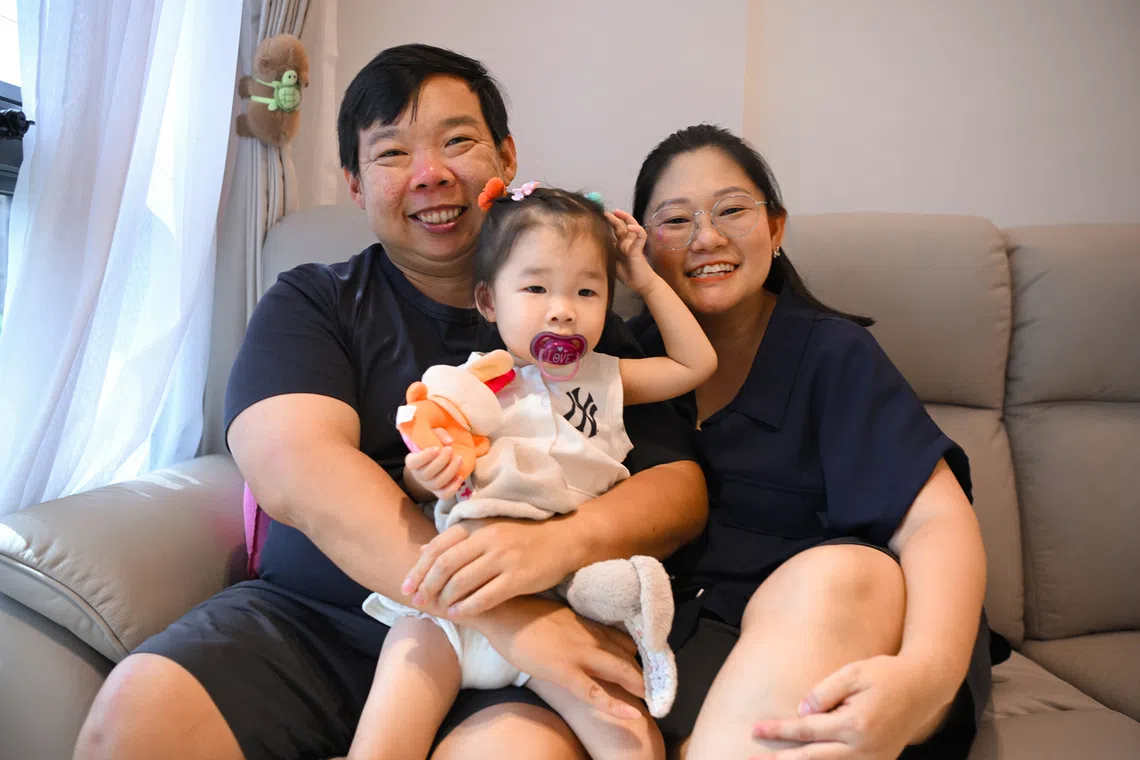
Ms Felicia Lee and her husband Cedric Ng went through two rounds of in-vitro fertilisation before they had their daughter Phoebe, now one year old.
Apart from having to consider their ages and the potential challenges of conceiving naturally, the couple opted for IVF to also prevent “any future babies from inheriting FAP from me”, Ms Lee said.
The couple went through two rounds of IVF before they had Phoebe, now one.
“My pregnancy was not an easy one, given my condition. I had to have Phoebe at SGH, where my colorectal doctors were on standby so that they could care for me as well,” she said.
Ms Lee gave birth via caesarean section and had to be re-admitted three days later owing to intestinal obstruction complications. She was hospitalised for a week.
“Going through all those challenges makes our daughter all the more precious,” she said.

Global Air Quality Crisis: Only 7 Nations Meet WHO Standards as US Monitoring Cuts Loom
SINGAPORE — In a startling revelation about the state of our planet's air, just seven countries worldwide met the World Health Organisation's (WHO) stringent air quality benchmarks last year. This alarming data comes as environmental researchers sound the alarm about worsening pollution tracking capabilities following the shutdown of crucial US-led global monitoring initiatives.

FDA Experts Unanimously Back JN.1-Targeted COVID Vaccines for 2026-2026 Season
In a decisive move to stay ahead of the evolving pandemic, US Food and Drug Administration (FDA) advisory panel members voted unanimously on Thursday (May 22) to recommend next-generation COVID-19 vaccines specifically designed to combat emerging JN.1 variant strains for the 2026-2026 immunization campaign.

WHO Nears Historic Pandemic Treaty Deal After Marathon Negotiations
GENEVA - After three years of intense negotiations, member states of the World Health Organization (WHO) are on the verge of finalizing a groundbreaking treaty to strengthen global pandemic preparedness, according to sources close to the talks. The discussions, which continued through Friday night into Saturday morning (April 12), have been temporarily paused until Tuesday as officials work to resolve remaining sticking points.

Healthy Ramadan & Hari Raya: Expert Tips to Stay Energized and Avoid Overindulgence
Fasting from sunrise to sunset during Ramadan can test one's endurance, making it crucial to maintain energy levels while resisting the temptation of overeating. As the holy month transitions into the joyous celebrations of Hari Raya Puasa (Aidilfitri), balancing festive feasts with mindful eating becomes essential for well-being.

Scientists Discover Bat Virus with Similar Traits to Covid-19, But Risk of Human Spread Remains Low
Chinese researchers have identified a bat coronavirus that shares a key trait with the virus behind Covid-19—it uses the same ACE2 receptor to invade human cells. While this raises concerns about potential future transmission, experts caution against alarm, as the virus currently shows limited ability to infect humans.

World Oral Health Day: The Surprising Connection Between Gum Disease and Heart Health
March 20 marks World Oral Health Day - the perfect opportunity to explore how your dental hygiene impacts far more than just your smile. Emerging research reveals startling connections between oral health and overall wellbeing that might surprise you.

Rise of Unqualified Online "Counsellors" Sparks Mental Health Concerns in Singapore
Mental health professionals in Singapore are raising alarms over the growing trend of untrained individuals offering counselling services on digital platforms. Experts warn this phenomenon poses serious risks, including potential misdiagnosis, harmful advice, and violations of client confidentiality.

Polio Eradication at Risk as US Funding Cuts Threaten Global Health Efforts
LONDON — The global fight to eliminate polio faces significant setbacks due to drastic funding cuts from the United States, which could delay eradication efforts and leave more children vulnerable to paralysis, warns a top World Health Organization (WHO) official.

Fluoride in Singapore: Should You Be Concerned About Its Effects?
A recent US study published in January has reignited debates about fluoride usage, particularly in water, after suggesting a possible link between higher fluoride exposure and lower IQ scores in children. The findings, featured in the Journal of the American Medical Association Pediatrics, have drawn criticism from some scientists who question the study's methodology while reaffirming fluoride's well-documented dental benefits.

Beyond Baby Blues: The Hidden Struggles of Postpartum Depression and Workplace Challenges
The journey of motherhood is often painted with images of radiant joy and unconditional love. Yet for many women, this transformative chapter comes with unexpected emotional turbulence that goes far deeper than temporary "baby blues."

Breaking the Silence: Singapore Women's Struggle with Undiagnosed Sexual Health Issues
SINGAPORE – When 30-year-old Aisyah (name changed for privacy) found herself unable to consummate her marriage in 2022, she and her husband immediately recognized this wasn't just newlywed jitters.

MaNaDr Strengthens Teleconsultation Protocols After Licence Revocation
Following criticism over excessively brief teleconsultations, telehealth provider MaNaDr has announced stricter measures to enhance service quality and rebuild patient trust.


